Opening Hours : Monday to Saturday - 09:00 a.m. - 06:00 p.m.

Doctors details

Years of experience
0

Dr. Rohini Josan Malik

Dr. Rohini Josan Malik is a Pediatric Dentist (Pedodontist) dedicated exclusively to the oral health, growth, development and overall well-being of infants, children, adolescents and children with special healthcare needs. With over a decade of specialized clinical experience, she has earned the trust of countless families through her gentle approach, clinical expertise and unwavering commitment to making every child’s dental journey a positive one.

Dr. Rohini’s practice extends far beyond treating teeth. She believes that every child deserves a safe, compassionate and supportive environment where dental visits become opportunities to build confidence, healthy habits and lifelong trust in healthcare.

Phone number:

(+91) 9914 446677

Address:

544, New York City, USA

Email address:

[email protected]

Responsibility:

Medical care

Her expertise encompasses all aspects of pediatric and preventive dentistry, including infant oral healthcare, preventive treatments, restorative dentistry, pulp therapies, pediatric crowns, esthetic restorations, management of early childhood caries, preventive orthodontics and comprehensive dental rehabilitation. She is particularly skilled in managing anxious, fearful and uncooperative children through advanced behavior guidance techniques that help create comfortable and stress-free treatment experiences.

A significant part of her practice is devoted to caring for children with special healthcare needs. She has extensive experience in providing dental treatment for medically compromised children and children with developmental and behavioral conditions, including Autism Spectrum Disorder (ASD). Her understanding of the unique sensory, emotional and communication needs of these children allows her to tailor treatment plans that prioritize both safety and comfort.

Since 2012, Dr. Rohini has been actively involved in delivering dental treatment under General Anesthesia and conscious sedation, enabling comprehensive care for very young children, special needs patients and those requiring extensive dental rehabilitation. Her hospital-based experience allows her to provide advanced treatment with the highest standards of safety and multidisciplinary support.

Dr. Rohini is a strong advocate of preventive dentistry and believes that establishing a “Dental Home” early in life can significantly influence a child’s long-term oral health. She works closely with parents, guiding them on infant oral care, feeding practices, oral hygiene habits, cavity prevention, dietary counselling and age-appropriate dental development. Her goal is not only to treat dental problems but to help families prevent them before they arise.

In addition to pediatric dentistry, Dr. Rohini has developed a special interest in Interceptive Orthodontics, Growth Modification and Airway-Focused Dentistry. She believes that many developing jaw discrepancies, harmful oral habits and breathing-related concerns can be identified and addressed during a child’s formative years, often reducing the need for more extensive treatment later in life.

Her expertise in growth guidance includes Rapid Palatal Expansion (RPE), myofunctional growth modification, habit correction, jaw development guidance, pediatric aligner therapy and preventive orthodontic treatment. She also has a trained clinical eye for evaluating sleep-disordered breathing and airway-related concerns in children from a dental perspective and focuses on non-surgical approaches that support healthy facial growth, breathing and overall development.

What truly distinguishes Dr. Rohini is her ability to connect with children. Her calm demeanor, patience and child-centred philosophy help transform dental visits into positive experiences that children look forward to rather than fear.

Whether she is helping a toddler through their very first dental visit, rehabilitating a child under General Anesthesia, guiding jaw development during growth, or supporting a child with special healthcare needs, her focus remains the same—to provide compassionate, evidence-based care tailored to the unique needs of every child and family.

Through every consultation, treatment and interaction, Dr. Rohini remains committed to one simple goal: helping children grow up with healthy smiles, healthy habits and the confidence that comes from receiving exceptional care from the very beginning.
Benefits of Dental Implants
  • Cases untreatable with conventional methods of dental bridges and dentures
  • Crown and bridge require two or more healthy teeth be ground and down to serve as abutments (posts) for a bridge, it avoids cutting down and overloading the natural teeth with conventional means.
  • For superior aesthetic results
  • Restores a patient’s self-esteem and confidence since it gives the feeling of regaining the real teeth
  • Surgery can commence after thorough diagnosis and treatment planning
  • Recipient site of the same size and shape as the implant is created in the jaw bone with drilling instruments
  • The implant is inserted into the site prepared.
  • Healing period of 3-6 months is required for the jaw bone to fuse with the implant
  • After this healing period the prosthesis is constructed over the implant and the treatment is completed

Indications of Dental Implants

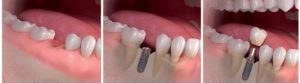
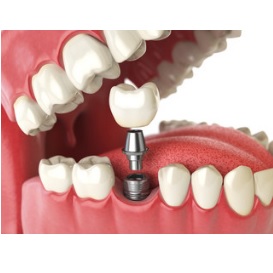
An implant is an excellent way to replace a missing tooth and keep a good-looking smile. A dental implant is a small titanium cylinder that’s surgically inserted into the bone of the jaw to replace the root of a missing tooth. An artificial tooth is attached to the implant.

Placing a dental implant after a tooth’s been lost can prevent a chain reaction of problems that could affect the entire mouth. When a tooth is lost, it changes the biting forces on the teeth next to the space, causing them to shift. When a tooth no longer has anything to chew against, it begins to extrude out of the socket. You can eventually end up losing that tooth, as well.

As your bite changes, it becomes increasingly difficult to chew your food, possibly damaging your jaw joint, the TMJ.

A bridge is another way to solve the missing-tooth problem. But two advantages of an implant over a bridge are that the teeth next to the space aren’t affected with an implant as they are in the preparation for a bridge. Also, the implant helps stop the ongoing bone loss that occurs once a tooth has been lost.

Restoring the mouth with a dental implant is accomplished in two phases. The first phase is the surgical placement of the implant. It is left under the gums for 3-4 months so the bone can attach to it. After healing, the second phase begins; the implant is re-exposed, and the new crown is made.

Though some of the steps might be different in your case, they usually include making impressions of your mouth. From these impressions, your dentist will make precise working models of your mouth, which are carefully mounted for proper alignment. The last step is the placement of the new crown. The success of the implant depends on the care you provide at home, and the support you receive through regular checkups and cleaning.

Missing several teeth? Implant-supported bridges can replace them. Dental implants will replace both your lost natural teeth and some of the roots.

What are the advantages of implant-supported bridges over fixed bridges or removable partial dentures?

Dental implants provide several advantages over other teeth replacement options. Implant-supported bridges replace teeth without support from adjacent natural teeth. Other common treatments for the loss of several teeth, such as fixed bridges or removable partial dentures, are dependent on support from adjacent teeth.

In addition, because implant-supported bridges will replace some of your tooth roots, your bone is better preserved. With a fixed bridge or removable partial denture, the bone that previously surrounded the tooth root may begin to resorb (deteriorate). Dental implants integrate with your jawbone, helping to keep the bone healthy and intact.

In the long term, implants are more aesthetic, functional and comfortable. Gums and bone can recede around a fixed bridge or removable partial denture, leaving a visible defect.

There are some implant systems (one-stage) that do not require this second step. These systems use an implant which already has the extension piece attached. Which can be loaded immediately.

Every case is different, and some of these steps can be combined when conditions permit.

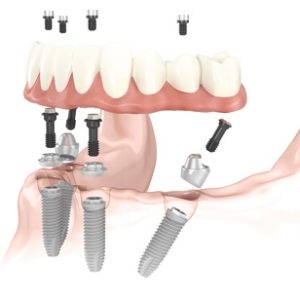
How does All-on-Four Technique Work?

All-on-Four technique involves a surgical procedure and is recommended to people who have lost almost all of their teeth. In this procedure implants are precisely placed in the mouth. These implants act as anchors for a complete dental bridge. In most cases, the bridge needs only four dental implants.

This modern technique requires less number of implants and is known to drastically reduce the recovery and treatment time. Once done with implants we install provisional teeth on the same day. These provisional teeth function exactly like natural teeth and allow you to regain your bite and beauty of your smile in a very short period of time until the fixed prosthesis is delivered.

  • Preservation of Bone Structure: All-on-four dental implants preserve the bone structure of the jaw. In other cases, dentures are placed on the gums and underlying bone which results in bone loss due to constant pressure.
  • Comfortable: The restored teeth are supported by implants instead of gums, so it does not rub and cause patches.
  • Improved diet: Dental Implants can easily withstand the forces of hard and crunchy food. This allows you to have healthy and variety of dishes.
  • Enhanced self-confidence: These implants do not move in your mouth while eating or talking. So, you can now confidently socialize without any fear of embarrassment.
  • Improved appearance: Teeth loss and jaw bone loss affects facial structure and you may look older than you actually are. All-on-four teeth preserve bone loss in your upper and lower jaws, and also support your cheeks and lips.
  • Short recovery and treatment time: Tilting of implants and immediate loading avoids time consuming procedures like bone grafting. Moreover less number of surgeries and treatment complexity also significantly reduces the time required to recover.
  • Cost- effective: This technique is not only less time consuming but cost effective as well in comparison to traditional treatment of soon to be edentulous and edentulous jaws.

A wide variety of implant types and procedures have been used with an overdenture as the means of a final restoration. Although it is used mostly with fixed types of prosthesis, on occasion single fixtures are placed on each side of the midline and an overdenture is fabricated over the fixtures.

In certain cases, immediate loading implant procedures are considered to be a better option than delayed implants. Immediate loaded implants are exposed to the chewing force immediately after implantation.

However, the exact definition of immediate loading may vary from same-day implant loading to a shortly-delayed loading (usually three days to one week) as the manufacturing of a fixed provisory prosthesis might be delayed due to dental lab constraints.

Although, immediate loaded implants are gaining recognition as an important option for certain categories of implant patients. Same day implants are not complex procedures but they do involve the fulfilment of certain criteria. There is a minimum amount of bone that is required and the placed implant has to be in a position to resist a minimum of chewing force.

In complex cases where a full arch is involved and more than four to six implants are placed in the maxillary or mandibular arch, the situation is paradoxically easier with the condition that all implants are granted from start a motionless function. The use of a large number of implants held together by an immediate prosthesis to prevent micro-motion at the bone-to-implant interface is a critical element in this protocol.

  • Immediate loading of an implant at the time of placement has become a viable treatment option, particularly in the aesthetic zone.
  • Factors influencing immediate loading – implant features, bone quality and quantity, initial stability.
  • Advantages for immediate loading- only one surgical procedure, shortened treatment time.

We at our practice believe in individualised and customised dental implant solutions including

  • a) Diagnostics (CT Scans)
  • b) Guided surgeries

Ranging from Single implant to full arch solutions (All–on–4, All –on–5, All–on–6) with screw retained vs cement retained prosthesis.

We also specialised in all advanced surgical and prosthetics (custom made teeth according to your need).

Dr.Sarah Benneth

Founder & Chief Dentist

Dr.Maya Lin

Cosmetic Dentist

Dr.Michale Reyes

Pediatric Dentist

Michel Anderson

Dental Hygienist

Book your appointment now!

Our team will contact you asap!