Opening Hours : Monday to Saturday - 09:00 a.m. - 06:00 p.m.
An attractive smile is a vital asset to personal self-confidence. The straightening of crooked teeth on an individual’s psychosocial well-being can be tremendous and orthodontics can make significant changes in increasing one’s quality of life. Research has even shown that having an attractive smile with well aligned teeth promotes positive impressions with regards to one’s intelligence, social and career success.
Orthodontics is a branch of dentistry that specializes in treating patients with improper positioning of teeth (malocclusion), which results in an improper bite.
Orthodontics also includes treating and controlling various aspects of facial growth (dento-facial orthopedics) and the shape and development of the jaw. Orthodontics also includes cosmetic dentistry; when the patient’s aim is to improve his/her appearance.
An orthodontist uses a range of medical dental devices, including headgears, plates, braces, etc. to help in:
Malocclusion literally means bad bite. Some children’s jaws and teeth do not develop properly. Malocclusion refers to crooked, misaligned teeth and a fault in the relation between the bottom and top set of teeth (the two dental arches).
Generally, malocclusions do not affect physical health, malocclusion is not a disease, and it is a variation in the normal position of teeth. However, it may impact on the shape of the person’s face and the appearance of their teeth, which can lead to embarrassment, a lack of self-confidence, and even depression.
Severe malocclusion may affect eating, speech and keeping the teeth clean. DCI say’s that approximately one third of all 12 year-olds in the country probably need orthodontic treatment.
Orthodontic treatment can be started right away and is done in 3 phases.
Preventive orthodontic treatment is intended to keep a malocclusion (“bad bite” or crooked teeth) from developing in an otherwise normal mouth. The goal is to provide adequate space for permanent teeth to come in. Treatment may require a space maintainer to hold space for a primary (baby) tooth lost too early or removal of primary teeth that do not come out on their own in order to create room for permanent teeth.
Interceptive orthodontic treatment is performed for problems that, if left untreated, could lead to the development of more serious dental problems over time. The goal is to reduce the severity of a developing problem and eliminate the cause. The length of later corrective orthodontic treatment may be reduced.
Examples of this kind of orthodontic treatment may include correction of thumb- and finger-sucking habits; guiding permanent teeth into desired positions through tooth removal or tooth size adjustment; or gaining or holding space for permanent teeth. Interceptive orthodontic treatment can take place when patients have primary teeth or mixed dentition (baby and permanent teeth). A patient may require more than one phase of interceptive orthodontic treatment.
Corrective orthodontic treatment is undertaken for problems that involve alignment of the teeth, how the jaws function and how the top and bottom teeth fit together. The goal of corrective orthodontic treatment is to correct the identified problem and restore the occlusion (the bite) to its optimum.
Treatment can begin while patients have primary teeth, when they have a mix of primary and permanent teeth, or when all permanent teeth are in. Treatment may consist of one or more phases, depending on the nature of the problem being corrected and the goals for treatment.
Orthodontic care may be coordinated with other types of dental treatment that may include oral surgery (tooth extractions or jaw surgery), periodontal (gum) care and restorative (fillings, crowns, bridges, tooth size enhancement, implants) dental care. When finished with corrective treatment, the patient must wear retainers to keep teeth in their new positions.
Following diagnostic procedures are performed
After the assessment is done, the exact treatment plan is decided.
There are two types of orthodontic appliances
The most common devices used in orthodontics. They are used when precision is important. Although the patient can eat normally with fixed appliances, some foods and drinks need to be avoided, such as sticky foods, hard sweets, or toffee. Examples of fixed orthodontic appliances include:
Braces (Metal and Ceramic)
Consisting of brackets and/or wires and bands. Patient has to see the dentist once a month so that the braces can be adjusted. The treatment course may last from several months to a number of years.
Fixed Space Maintainers
If the child loses milk teeth, a space maintainer will stop the two teeth at either side of the spaces from moving into it until the adult tooth comes through.
Special Fixed Appliances
These may be recommended to control tongue thrusting or thumb sucking.
These are typically used for treating minor problems, such as preventing thumb sucking or correcting slightly crooked teeth. They should only be taken out when cleaning, eating or flossing.
Examples of removable appliances include:
Aligners
An option instead of traditional braces for adult patients. They are virtually unnoticeable by other people and can be taken out when patients brush their teeth, floss, or eat.
Headgear
The aim is to slow down upper jaw growth, and keeping the back teeth in position while the front ones are pulled back.
Lip & Cheek Bumpers
Specially made to relieve the pressure of cheeks or lips on the teeth.
Palatal Expander
An appliance designed to make the arch of the upper jaw wider.
Removable Space Maintainers
An alternative to fixed space maintainers.
Splints (jaw repositioning appliances)
Splints are commonly used for TMJ (temporomandibular joint disorder) syndrome.
Metal braces are the most common type of braces for orthodontic patients. Today’s metal braces are much smaller, flatter, and more comfortable than in the past. Patients of all ages choose metal braces to help them achieve straight, beautiful smiles.
Ceramic braces are popular than the traditional braces. Same size and shape but are tooth colored and are very popular amongst school and college going students due to the different colors of bands (elastics).
Aligners
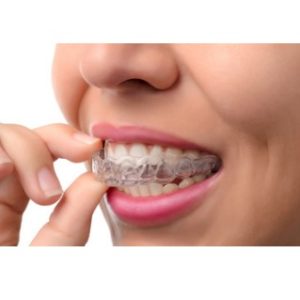
Orthodontic aligners can straighten a dental patient’s teeth without the wires and brackets of traditional braces. The aligners consist of a sequence of clear, removable trays that fit over the teeth to straighten them.
Each tray must be worn by the patient for a specified amount of time—usually around 16 – 20 hours a day for two weeks–before the patient can progress to the next tray. In most situations, the aligners can straighten teeth in anywhere from six to 12 –24 months.
Orthodontic aligners are suitable for patients with mild or moderate crowding, or minor spacing issues. They may not be appropriate for patients with severe crowding or spacing. Unlike traditional braces, the trays can be removed for brushing, flossing, and eating. Because the trays are clear, patients can undergo this type of orthodontic treatment without the usual discomfort associated with regular braces.
Orthodontic aligners have more advantages over the traditional braces as they are more comfortable, removable, and lesser visits as compared to the traditional braces.
For beautiful smiles with all the treatment modalities present under a roof visit Max Dental Care, Mohali.
(+91) 9914 446677
Our team will contact you asap!